
THT Terminal Auto Insertion — Replacing Manual FASTON and Eyelet Seating
If your THT line still relies on hand-seating FASTON tabs and eyelets, clinch quality drifts with every operator. Run the Terminal Seat Check, then see how the S-7000T verifies each insertion in real time.
Aug 25, 2026 · Updated Aug 31, 2026 · Jason Wu
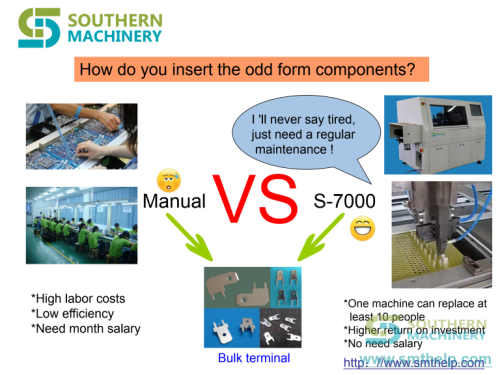
If your THT line still seats FASTON tabs, eyelets, and reel-fed terminals by hand, you already know the cost: inconsistent clinch quality, insertion stress that cracks solder joints, and operators who can't keep up with a reflow-fed SMT line. Southern Machinery designs and manufactures the S-7000T terminal insertion machine to close that gap — a servo-controlled, vision-corrected THT auto insertion machine built for smart EMS factory PCB assembly.
Watch the short demo: THT Terminal Auto Insertion machine — design and manufacturing for Smart EMS factory PCB assembly.
The cost of hand-seated terminals
Manual terminal seating is a repetitive-motion task with three compounding failure modes:
- Clinch quality drifts by operator. Seating depth and clinch angle vary from person to person, and an inconsistent clinch is a latent solder-joint defect that only surfaces under vibration or thermal cycling.
- Insertion stress cracks joints. Forced or misaligned terminals stress the plated through-hole; the damage is invisible until field returns.
- Throughput cannot scale. One operator — often two on high-terminal-count boards — is locked to the bench, and output fades as the shift wears on.
The parts in question are exactly the ones a standard pick-and-place system struggles with: reeled FASTON/TAB quick-connect terminals, pins, and eyelets that must be pushed into plated through-holes and clinched to hold before wave soldering.
The Terminal Seat Check
Score your current terminal step before you automate. The check uses your own boards:
- Count terminals per board. High-terminal-count boards (power supplies, ballasts, appliance control boards) are where manual seating costs the most.
- Measure clinch variation. Pull a sample of hand-seated terminals — how consistent is depth and angle across operators?
- Confirm traceability gaps. Can you prove, board by board, that every terminal seated? Manual seating leaves no data trail.
- Tally operator-hours. How many bench operators does terminal seating consume per shift, and what is the repetitive-motion risk?
The check doesn't tell you to buy. It sizes the labor, quality, and traceability gap your line carries today.
The machine: how the S-7000T inserts
The S-7000T automatically feeds, inserts, and clinches reeled through-hole terminals into a PCB before wave soldering. On the published configuration, it runs at 5,000–6,000 CPH with servo control, feeds tape at a 5.08 mm pitch, and inserts up to 2 terminals per second at that pitch. Up to four different components can run on one machine, at up to four insertion angles across 360° in 1° increments, with an optional quick-change head for fast changeover.
Two engineering details matter most to buyers:
- Insertion verification. The S7000 series uses electrical continuity or discrete pin-penetration sensing, so every terminal is confirmed seated in real time. No separate QC step is required, and the data is stored on the system PC for full traceability.
- Stress-controlled clinching. The machine is built to the IPC-9704 stress-test standard, holding insertion stress within ±400 µε, with inward, outward, or "N" clinch selectable per program.
The machine is designed around the parts hardest to automate elsewhere:
- Reeled tape terminals — Zierick-type (e.g., P/N 1021/6021/1198/6198) and TE Connectivity TAB/FASTON terminals in 6.35 mm and 4.75 mm tab widths.
- Bulk or bowl-fed terminals — loose terminals oriented and guided into the insertion head.
- Pins and eyelets — discrete pin or eyelet insertion where penetration sensing verifies each part seated correctly.
Where it fits in a complete line
The S-7000T sits inside a mixed SMT/THT line that Southern Machinery supplies as one ecosystem:
- SMT section — solder paste printing, SPI, pick-and-place, reflow, AOI.
- THT section — radial insertion (S-3000/S-3010B), axial insertion (S-4000), odd-form insertion (S-70LD/S7000 series), and terminal insertion (S-7000T) for parts that can't go through placement.
- Soldering — lead-free wave soldering (S-WS450, S-WS350B) or selective soldering for the through-hole side.
- Board handling — loaders, unloaders, conveyors, and buffer stations; loader/unloader board handling is a standard companion, ready for Industry 4.0.
- Inspection and post-process — 3D SPI/AOI, X-ray, PCB cleaning, depaneling.
The machine's Windows-based system runs on an industrial PC with a motion control card, and an RS-232C interface connects to your MES. Production data, equipment parameters, and I/O diagnostics are all on the host — the insertion step stops being a black box.
Make it a recurring evaluation, not a one-off
Terminal patterns repeat board after board in appliance, automotive, power, and LED products. Re-run the Terminal Seat Check when you add a terminal-heavy board, change a terminal supplier, or see clinch-related field returns. Where a product family repeats the same terminal pattern, the case for automation is usually already made.
Your next step
Send your terminal samples and PCB drawings to info@smthelp.com or WhatsApp +86 136 0256 2576. The team confirms machine configuration, tooling, and line layout for your application — including the 0.5–1.2 mm terminal thickness range, 380 × 280 mm standard PCB size (enlarged sizes customizable), and MES connectivity. Southern Machinery (founded 2011, Shenzhen, China) serves 237+ global customers with complete SMT/THT lines from one supplier.
FAQ
What types of terminals can a THT terminal insertion machine handle? Reeled tape terminals such as Zierick-type and TE Connectivity FASTON/TAB (6.35 mm and 4.75 mm tab widths), plus bulk or bowl-fed terminals, pins, and eyelets. Terminal thickness capability depends on the insertion head; the S-7000T covers 0.5–1.2 mm.
Why is clinching important in terminal insertion? Clinching bends the terminal leads over on the solder side so the part stays seated through wave soldering. Inward, outward, and "N" clinch styles are selectable per program. Controlled clinching also limits mechanical stress on the plated through-hole and solder joint — the S-7000T is built to the IPC-9704 stress-test standard with insertion stress within ±400 µε.
Can the machine verify that a terminal was inserted correctly? Yes. The S7000 series uses electrical continuity or discrete pin-penetration sensing to confirm each terminal is seated in real time, storing data on the system PC for full traceability and removing the need for a separate inspection step.
How does the terminal insertion machine connect to a smart factory or MES? The machine runs a Windows-based system on an industrial PC and provides an RS-232C interface that can connect to an MES. Production data, equipment parameters, and I/O diagnostics are accessible on the host, and loader/unloader board handling can be integrated for Industry 4.0 material flow.
What is the typical throughput of the S-7000T? The published configuration runs at 5,000–6,000 CPH with servo control and inserts up to 2 terminals per second at a 5.08 mm tape pitch. Up to four different components can run in one machine at up to four angles.
What PCB size does the machine accept? The standard S-7000T handles PCBs up to 380 × 280 mm, with enlarged sizes customizable. The insertion hole should be approximately 0.5 ± 0.1 mm larger than the component foot for reliable seating.
Jason Wu
Founder & CEO, Southern Machinery (Shenzhen Southern Machinery Sales and Service Co., Ltd.)
Email: jasonwu@smthelp.com / info@smthelp.com
WhatsApp: +86 13602562576
Catalog & manuals: file.autoinsertion.com | Machine photos: ph.smthelp.com
LinkedIn: linkedin.com/in/smtsupplier | YouTube: youtube.com/c/Smthelping
Comments
Comments appear after approval.