
TV Board THT Assembly: Automate Odd-Form Insertion with the S-70LD
Hand-inserting transformers and connectors on TV boards is the slowest, least controlled station on the line — run the Odd-Form Insertion Audit, then see how the S-70LD automates it.
Aug 16, 2026 · Updated Aug 31, 2026 · Jason Wu
A TV main board has one of the densest SMT sides in consumer electronics, and on the reverse side are the parts no one wants to insert by hand: power and flyback transformers, relays, fuse holders, terminal blocks, HDMI connectors, and tall electrolytics. Most factories still populate that side manually. It's the slowest station on the line, the hardest to staff, and the one that quietly ships field failures—because a transformer pin sitting half a millimeter high can look fine at the workbench but fail in a customer's living room.
Southern Machinery's S-70LD Odd-Form Insertion Machine moves that work into a vision-guided inline station, designed for the irregular through-hole component families that radial and axial inserters can't handle.
Why Manual Odd-Form Insertion Hurts Quality, Capacity, and Cost
The problem isn't careless operators. It's that odd-form parts give them nothing repeatable to work with.
- Cycle time is a range, not a number. A connector might take four seconds from an experienced operator and ten from a new one. Line balancing built on the optimistic figure falls apart on the night shift.
- Seating depth is never verified. "Floating high" is the classic manual defect—the part looks inserted, but one or two leads never reach the plated through-hole, so the wave never forms a proper joint.
- Polarity depends on tired eyes. Electrolytics and multi-pin transformers presented loose in trays are easy to load 180° out, and nothing at the bench catches it.
- Defects surface after the expensive steps. Misinsertion appears at AOI or test, after soldering. Rework means desoldering, clearing holes, reinserting, and re-soldering—three to five minutes per board.
- Headcount is the only throughput lever. More volume means more benches and more training, so cost per board never improves with scale.
The Odd-Form Insertion Audit
Run this on your own TV or power board before you read a quotation. It costs one shift of observation.
1. Map the odd-form BOM. List every through-hole part that isn't on axial or radial tape, recording body size, height, and lead pitch. If most of that list falls inside 3 × 3 mm to 30 × 30 mm and under 50 mm tall, it sits inside the S-70LD envelope and automation becomes a real option.
2. Time the manual station honestly. Stopwatch the same insertions across three operators and two shifts, not one demonstration run. The spread between fastest and slowest is capacity you're already losing, and it's usually wider than the internal average.
3. Classify the feed format. Sort that list into tape, tube, tray, and loose. Tray and loose parts need vibration-bowl feed plus vision; tape parts don't. Feeder count and type drive the configuration far more than a headline CPH figure.
4. Trace where each defect is caught. Pull three months of AOI and test data and mark the failures that originate at insertion—floating high, reverse polarity, wrong part. Multiply by rework minutes and field-return cost. That number, not the wage, is the argument for automating.
The audit usually lands in the same place: labor is the small line item and rework is the large one.
The Machine: How the S-70LD Works
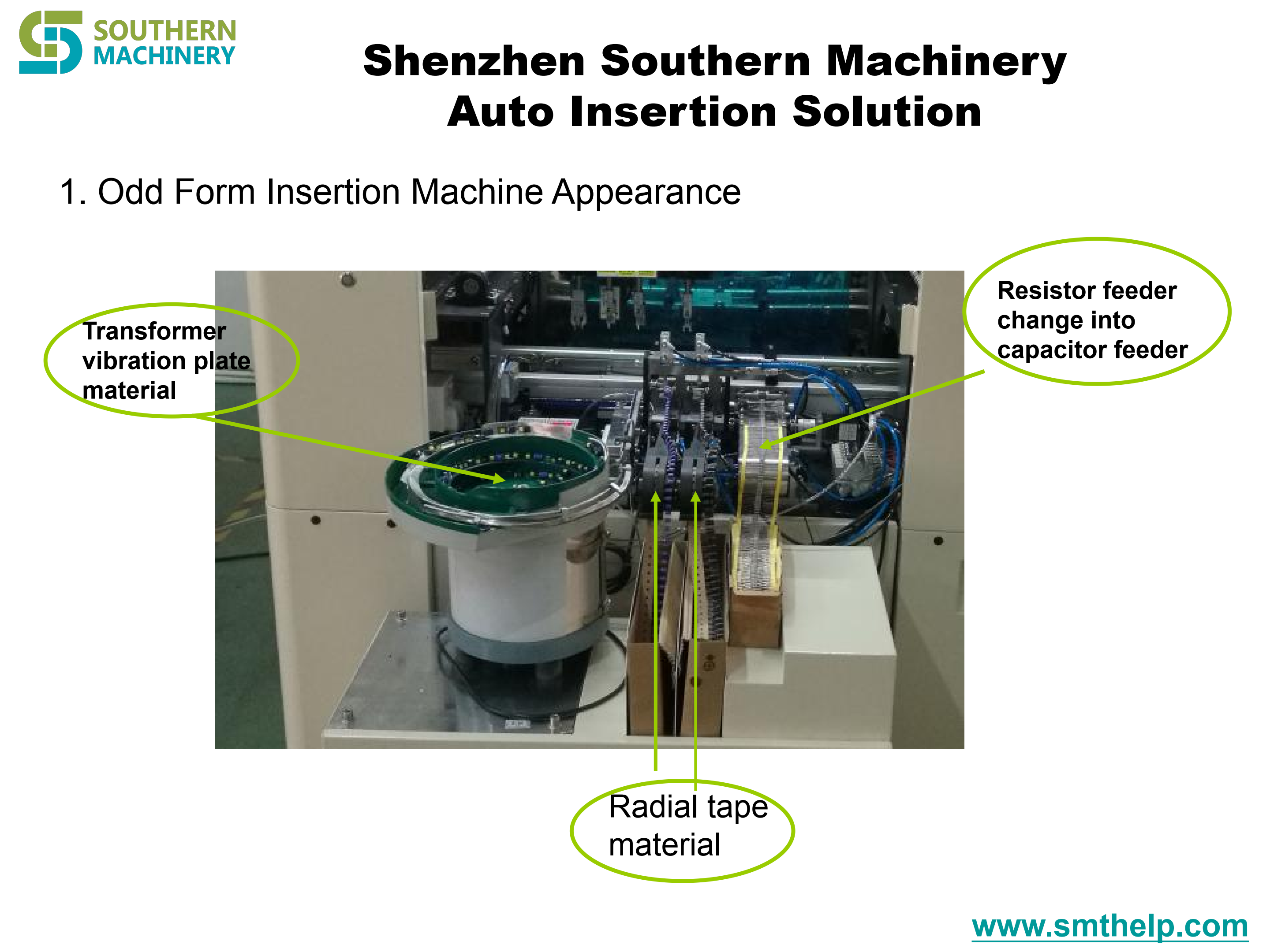
The S-70LD is an inline odd-form inserter driven by an industrial PC with vision guidance. Components arrive from four adjustable feeders—tape or vibration bowl—and the vision system locates each body and reads its lead geometry regardless of how it was presented in the feeder. Polarity is checked before the head commits: a part sitting 180° out is rejected rather than pushed into the board. Four insertion heads then seat every lead to a programmed depth under controlled force, which is what eliminates floating-high and half-seated pins. Boards enter and leave via SMEMA handshake, so the machine drops into an existing DIP conveyor instead of becoming an island.
| Parameter | Specification |
|---|---|
| Component envelope | 3 × 3 mm to 30 × 30 mm |
| Component height | Up to 50 mm |
| PCB size range | 50 × 50 mm to 300 × 300 mm |
| Insertion heads | 4 |
| Feeders | 4, tape or vibration bowl, adjustable |
| Insertion speed | 4,000 CPH (3,800 CPH for radial resistor insertion) |
| Placement accuracy | ±0.05 mm |
| Vision | Industrial PC, lead-geometry recognition, polarity check with 180° reject |
| Power / air supply | 220 V AC, 0.8 kVA / 0.4–0.6 MPa |
| Noise / weight | ≤75 dB / approx. 1,000 kg |
Confirm the envelope against your tallest transformer and widest connector during quotation.
Where It Fits on the Line
The S-70LD sits in the THT block of a mixed-technology line. SMT side: printing, SPI, placement, reflow, AOI. Then radial auto insertion for standard taped parts—the S-3010B, for example—followed by the S-70LD for everything irregular, then lead-free dual wave soldering such as the S-WS450, then cleaning, depaneling, and inspection. Because boards return to the same conveyor at the same height, existing wave solder, cleaning, and handling equipment stays as it is, which is what makes the retrofit affordable on a running line. Tape-fed odd-form work also generates carrier-tape waste, handled by a reel scrap tape cutter such as the S-680A.
The ROI Case
Model four effects separately rather than as one blended saving. Capacity: insertion time stops depending on the operator or the hour, so takt becomes predictable. Quality: consistent seating depth eliminates floating high, and vision polarity checking eliminates reverse insertion—the two defect families that cost the most because they surface after soldering. Scrap and rework: each misinsertion caught before the wave saves three to five minutes of desolder-and-reinsert plus a second thermal cycle, and on an eight-to-ten-pin transformer a single unseated lead can become a field failure worth many times the board's assembly value. Labor: the station stops absorbing operators you can't hire.
Re-run the Odd-Form Insertion Audit each quarter and after every new SKU. That audit-and-improvement loop closes the gap between the quote and the line's actual behavior. Treat any payback figure as a planning benchmark built from your own defect and labor data.
Your Next Step
Send your TV or power board Gerber, the odd-form section of your BOM, and photos showing how those parts arrive—tray, tube, tape, or loose. Our engineers return an S-70LD feeder and head configuration, a cycle-time estimate for your joint count, and a layout showing where it lands in your DIP line. Southern Machinery (Shenzhen, since 2011, 237+ global customers) supplies SMT and THT line equipment with installation, training, and spare-part support.
FAQ
What is an odd-form insertion machine? A THT automation station that places through-hole components which don't fit axial or radial tape formats—transformers, relays, connectors, terminal blocks, fuse holders—using vision guidance and programmable tooling to locate, orient, and seat them.
Does it replace wave soldering? No. The S-70LD only seats components into the plated through-holes. Boards still pass through wave soldering, which forms all through-hole joints in one pass. The machine is designed to sit upstream of the wave.
How is it different from radial insertion? Radial inserters run standard taped parts at very high speed. Odd-form machines handle trays, tubes, and vibration-bowl feed—larger bodies, irregular shapes, varying lead pitch. Many DIP lines run both.
Can it be retrofitted to a running line? Yes. It accepts and returns boards via SMEMA handshake on the same conveyor, so existing wave soldering, cleaning, and conveyor infrastructure is unchanged.
Jason Wu
Founder & CEO, Southern Machinery (Shenzhen Southern Machinery Sales and Service Co., Ltd.)
Email: jasonwu@smthelp.com / info@smthelp.com
WhatsApp: +86 13602562576
Catalog & manuals: file.autoinsertion.com | Machine photos: ph.smthelp.com
LinkedIn: linkedin.com/in/smtsupplier | YouTube: youtube.com/c/Smthelping
Comments
Comments appear after approval.