
Odd-Form Hand Insertion Limits Output — Target a 10x Labor Benchmark
Hand-inserted odd-form parts cap your DIP line. Run the DIP Labor Audit, then see how vision-guided insertion targets a 10x labor benchmark.
Aug 20, 2026 · Updated Aug 31, 2026 · Jason Wu
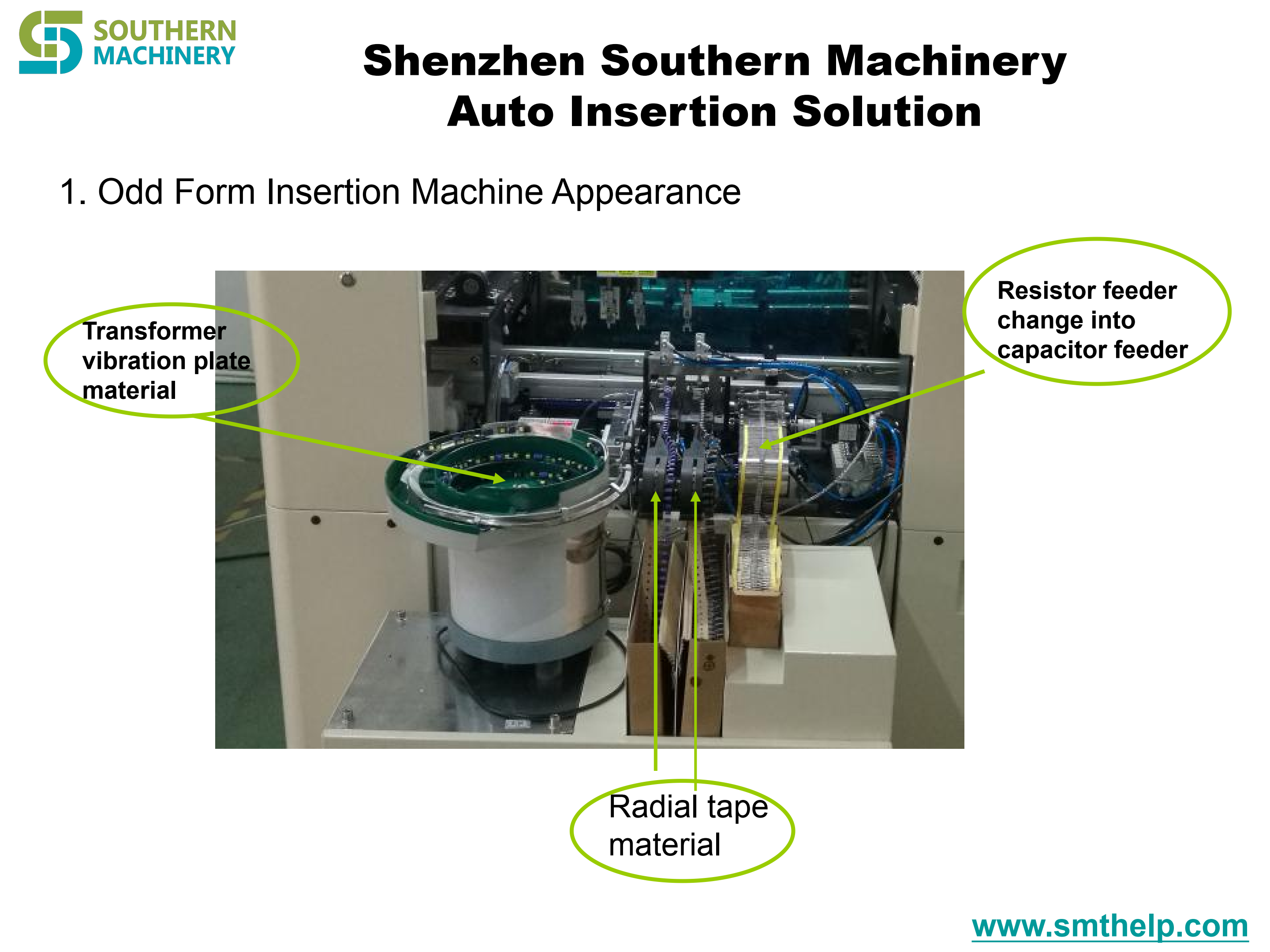
On the DIP line, odd-form parts — connectors, relays, transformers, terminal blocks — are still inserted by hand in most EMS factories. That manual step is where cost and quality vary most: floating-high leads, reverse insertion and missed components trace straight back to operator skill and overtime, and the wave line waits on it.
Southern Machinery's odd-form insertion machine takes these non-standard parts off the bench and places them with a vision-guided automatic platform — seating every lead to a set depth and checking orientation before placement. Reaching a 10x labor-cost benchmark is the automation target: the same output with a fraction of manual labor, modeled against your own numbers. The machine reads lead geometry, checks polarity and seats leads to a set depth, removing the human variance that produces floating-high, misinsertion and reverse-insertion defects.
Why manual odd-form breaks cost and quality
- Floating high — leads not seated, caught at wave or test.
- Reverse / misinsertion from orientation and polarity errors.
- Labor drift — output tied to operator skill and overtime, not capacity.
- Training churn — every new hire resets the learning curve and defect rate.
- Scalability ceiling — output cannot grow without recruiting and training more operators.
- Rework cascade — a misinserted odd-form part fails at wave and pulls the board back through the line.
The DIP Labor Audit
1. Count hand-inserted parts. List odd-form components still plugged by operators per board.
2. Tally the defects. Floating-high, reverse, miss rates from recent batches.
3. Price the labor. Operators, training and overtime behind the DIP bench.
4. Model the target. Estimate the labor step-change if those positions are automated.
The Vehicle: how the odd-form insertion machine works
Tray, tube, tape or loose odd-form parts feed the head; vision reads lead geometry and polarity, then the head seats each lead to a programmed depth and verifies orientation before release. Feeders present tray, tube, tape or loose parts in the format the head can handle, and programs are built from PCB data and mark points so changeover is teach or offline, not manual.
| Parameter | Specification |
|---|---|
| Machine type | Vision-guided odd-form THT auto insertion |
| Component input | Tray, tube, tape, loose (odd-form parts) |
| Insertion check | Vision reads lead geometry, polarity, depth |
| Programmability | PCB data, mark points, teach / offline programs |
| Line role | THT insertion block, before wave soldering |
| Integration | Inline with radial / axial / pin insertion |
| Compatible line | S-3010B radial, S-4000 axial, S-7020 pin, S-WS450 wave |
Where it fits in a complete line
After SMT reflow and AOI, boards enter THT: radial to S-3000/S-3010B, axial to S-4000, pins/eyelets to S-7020, and odd-form to this machine, then wave soldering (S-WS350B/S-WS450) joins all joints. One supplier engineers the cell — feeders, nozzles, balancing and training. Because Southern Machinery designs the insertion machines, board handling and wave soldering, one supplier can engineer the whole THT cell — feeder and nozzle selection, line balancing and training — instead of the buyer integrating several vendors. The odd-form station links to upstream radial/axial/pin insertion through conveyors and buffers so the line flows without manual lifting.
Buffer conveyors between SMT and THT keep the line flowing without manual lifting, and one supplier's engineering team tunes feeder, nozzle and balance for the whole cell. The result is a DIP bench that scales with machine capacity instead of operator proficiency, and vision-checked placement means orientation errors never reach the wave.
The ROI case
The return is counted on three lines: direct labor reduction as manual positions are removed; quality cost from vision-checked insertion removing floating-high and reverse defects; and scalability as throughput becomes machine capacity, not operator proficiency. Reaching a 10x labor-cost benchmark is the automation target, not a fixed outcome — quantify your headcount, defect and rework, then model it with your own numbers. Keep this audit-and-improvement loop running as new odd-form parts enter the line.
The three-line return — labor, quality and scalability — is a planning model, not a promise; the actual number depends on your headcount, defect rate and rework cost, so build it from your own data. Many EMS factories treat the 10x labor benchmark as the design target for the DIP bench and track progress board by board as insertion coverage grows.
Make it a recurring check
Re-run the DIP Labor Audit when odd-form count grows, defects rise, or output depends on overtime; Southern Machinery advises on feeder, nozzle and line balancing. Re-run the DIP Labor Audit each time a new odd-form component appears or output depends on overtime.
Your next step
Send your odd-form component list and board data and our engineers recommend an insertion configuration. Southern Machinery (Shenzhen, China, since 2011, 237+ global customers) supplies radial, axial, pin and odd-form insertion, board handling, wave soldering and custom nozzles with training and spares.
FAQ
What is an odd-form insertion machine? A THT auto inserter that places non-standard through-hole parts — transformers, relays, connectors, terminal blocks — replacing manual DIP insertion.
Which parts can it handle? Components outside radial/axial tape — trays, tubes, tape or loose: transformers, relays, connectors, fuse holders, electrolytics.
How does it improve quality? Vision verifies lead geometry and polarity, seats to programmed depth, removing floating-high, leak and reverse-insertion defects.
Where does it sit in the line? In the THT insertion block, after radial/axial, before wave soldering — Southern Machinery can supply the whole cell.
Jason Wu
Founder & CEO, Southern Machinery (Shenzhen Southern Machinery Sales and Service Co., Ltd.)
Email: jasonwu@smthelp.com / info@smthelp.com
WhatsApp: +86 13602562576
Catalog & manuals: file.autoinsertion.com | Machine photos: ph.smthelp.com
LinkedIn: linkedin.com/in/smtsupplier | YouTube: youtube.com/c/Smthelping
Comments
Comments appear after approval.