
Odd Form Insertion Machine for THT Assembly Automation
Transformers, relays and connectors still get placed by hand on many THT lines. Run the DIP-Bench Tally, then see how an odd form insertion machine takes that work off the bench.
Aug 26, 2026 · Updated Aug 31, 2026 · Jason Wu
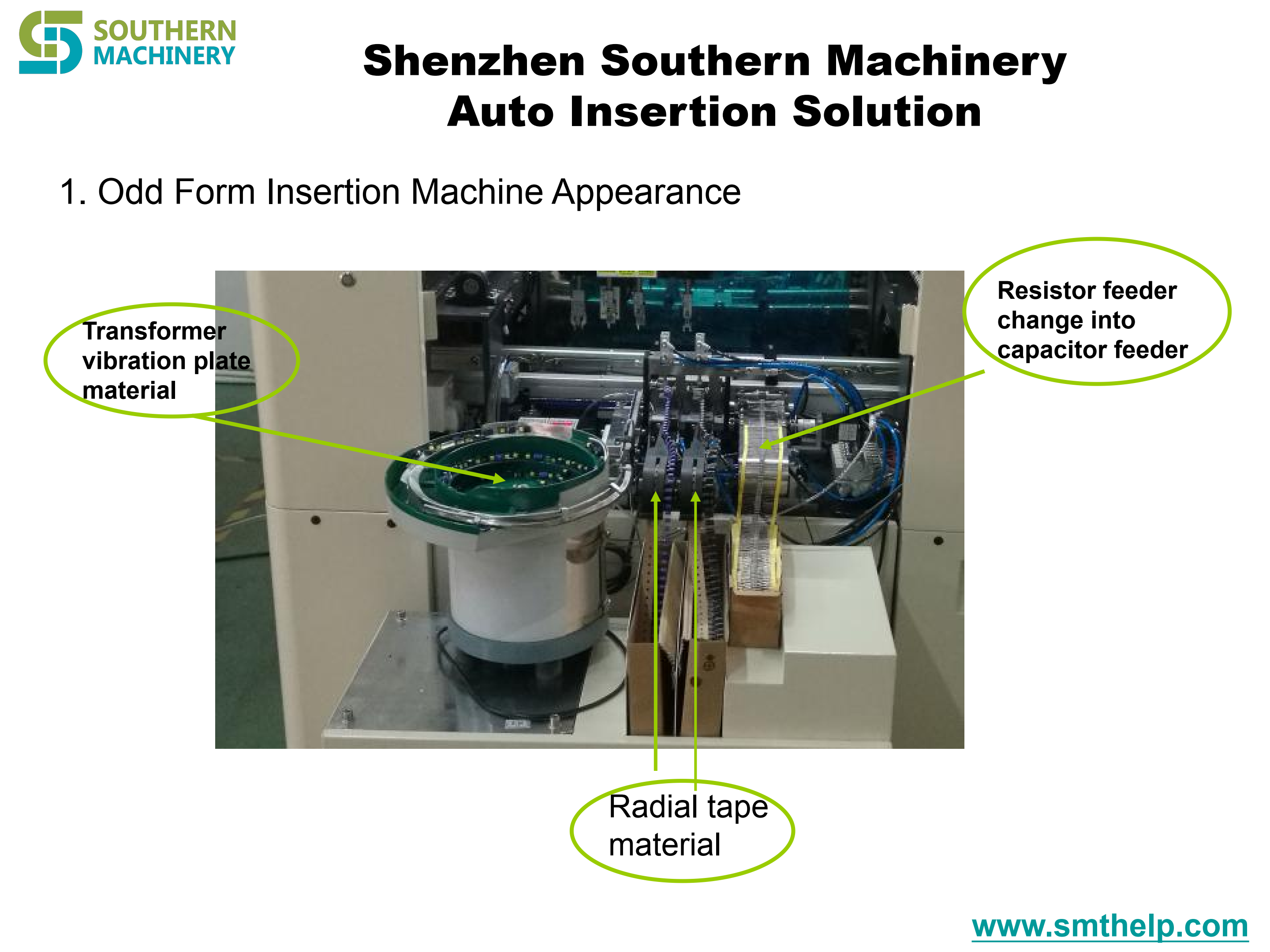
The last hand on your automated floor is probably a DIP bench — an operator placing transformers, relays and connectors one at a time because no radial or axial inserter will take them.
Odd form (special-shaped) through-hole components are the parts that never fit a standard tape feeder: transformers, relays, terminal blocks, solenoids, switches, fuses and large electrolytic capacitors. On many THT lines they are still inserted by hand, which quietly caps throughput and reintroduces the defects automation was meant to remove. This guide gives you a framework to size the opportunity before you ask for a quote.
The bench that never scaled
Manual DIP insertion hurts in three ways that simple headcount hides:
- Hiring and turnover. Insertion operators are hard to hire, train and keep. Every new hire resets the learning curve on your hardest boards.
- Quality variance. Hand placement produces floating components, missing insertions, misinsertions and reverse (anti-polarity) parts that survive visual check and fail at test.
- Output capped by hours. Throughput tracks operator skill and attendance, not demand — so a volume spike cannot be met by working faster.
If more than a couple of operators are placing parts that do not run on radial or axial feeders, an odd form inserter is worth evaluating.
The DIP-Bench Tally
Run this on your current line before you look at any machine. It needs no equipment:
- Count the bench. How many operators place non-radial, non-axial THT parts per shift?
- List the part families. Transformers, relays, connectors, coils, large capacitors — which dominate your THT content?
- Tally the defect types. Over the last month, how many reverse, missing or floating insertions reached test or rework?
- Note the changeover pain. How often does the mix change, and how long does retraining a bench take each time?
The tally tells you the labor and quality exposure you are carrying — and whether consolidating those stations is worth a conversation.
The Vehicle: how odd form insertion works
An odd form insertion machine uses industrial computer control with vision guidance to locate, orient and insert special-shaped parts onto the PCB — the same DIP work a manual line does, with machine repeatability. Southern Machinery's odd form inserters (including the S-70LD and S-7000 families) are built around the practical pain points above:
- Flexible feeding. Parts arrive in trays, tubes, vibration/bowl feeders or tape; feeder flexibility sets your changeover effort.
- Vision and guidance. Board mark recognition and component lead inspection confirm polarity before insertion — which removes reverse and misinsertion defects at the source.
- Tooling and force control. Multiple heads, swappable nozzles/grippers and monitored insertion force or clinching for high-vibration applications.
- Stored programs. Offline programming, a component database and recipe management shorten changeovers across many products.
When several manual insertion stations are consolidated into one cell supervised by a single operator, direct labor per board can fall by an order of magnitude — the planning figure behind the "10x labor saving" label used in our demonstration video. Treat it as a benchmark to validate against your own headcount and shift pattern, not a guarantee.
Where it fits on a complete line
Odd form insertion drops into a full SMT + THT flow:
- Front end: solder paste printing, pick-and-place and reflow (Southern Machinery SMT machines and peripherals).
- THT section: axial (S4000 series), radial (S3000 / S-3010B), pin-eyelet-terminal (S7020 series) and odd form machines together cover the complete through-hole mix.
- Soldering: boards flow to wave soldering (e.g., the S-WS450) or selective soldering for reliable joints on all leads.
- Handling and quality: magazine loaders, conveyors and buffers keep boards moving; AOI/SPI and X-ray catch defects before shipment.
Because one supplier quotes, commissions and supports the insertion machines, wave soldering, board handling, feeders and custom nozzles, the whole line is engineered as one system rather than patched together.
Make it a recurring tally
Product mix drifts: a new transformer, a taller capacitor, a connector change. Re-run the DIP-Bench Tally whenever your top-five boards change — the parts that looked "fine by hand" last quarter may be the ones costing you rework this quarter.
Your next step
Send your board mix and current DIP headcount to jasonwu@smthelp.com or WhatsApp +86 136 0256 2576. The engineering team helps you size the machine, feeders and line integration for your smart EMS factory — and quotes realistic cycle times only after seeing your actual components.
FAQ
What is an odd form insertion machine? A THT automation machine that places special-shaped through-hole components — transformers, relays, connectors, large capacitors — using programmable motion and vision guidance.
Which components can it place? Parts standard radial and axial inserters cannot: tall, heavy or irregularly packaged components, typically presented in trays, tubes or vibration feeders.
Can it integrate with an existing wave soldering line? Yes. Odd form inserters run as inline or offline stations; boards flow from insertion through wave soldering and into inspection, with conveyors linking the stages.
How many operators does it need? One operator can supervise several machines, since loading, insertion and unloading are automatic. This is the main source of the labor reduction versus manual benches.
Does it inspect before insertion? Vision guidance recognizes board marks and inspects components before insertion, preventing polarity errors, misinsertions and missing parts.
Jason Wu
Founder & CEO, Southern Machinery (Shenzhen Southern Machinery Sales and Service Co., Ltd.)
Email: jasonwu@smthelp.com / info@smthelp.com
WhatsApp: +86 13602562576
Catalog & manuals: file.autoinsertion.com | Machine photos: ph.smthelp.com
LinkedIn: linkedin.com/in/smtsupplier | YouTube: youtube.com/c/Smthelping
Comments
Comments appear after approval.