
Switches, Connectors and Terminals Do Not Need Manual Insertion
Odd-form THT parts are the last holdout of manual labor in PCB assembly — and the biggest source of scrap and rework.
Aug 18, 2026 · Updated Aug 31, 2026 · Jason Wu
Switches, connectors, terminals, eyelets and large round pins do not arrive in standard axial or radial tape. They need orientation, forming and careful seating, so they stay on the manual bench long after the rest of the board is automated. Southern Machinery's published assessment of that bench is blunt: low efficiency, poor quality, difficult processing, high defect and scrap rates, and high manufacturing cost. The parts that resist automation hardest are precisely the parts that punish you for not automating them.
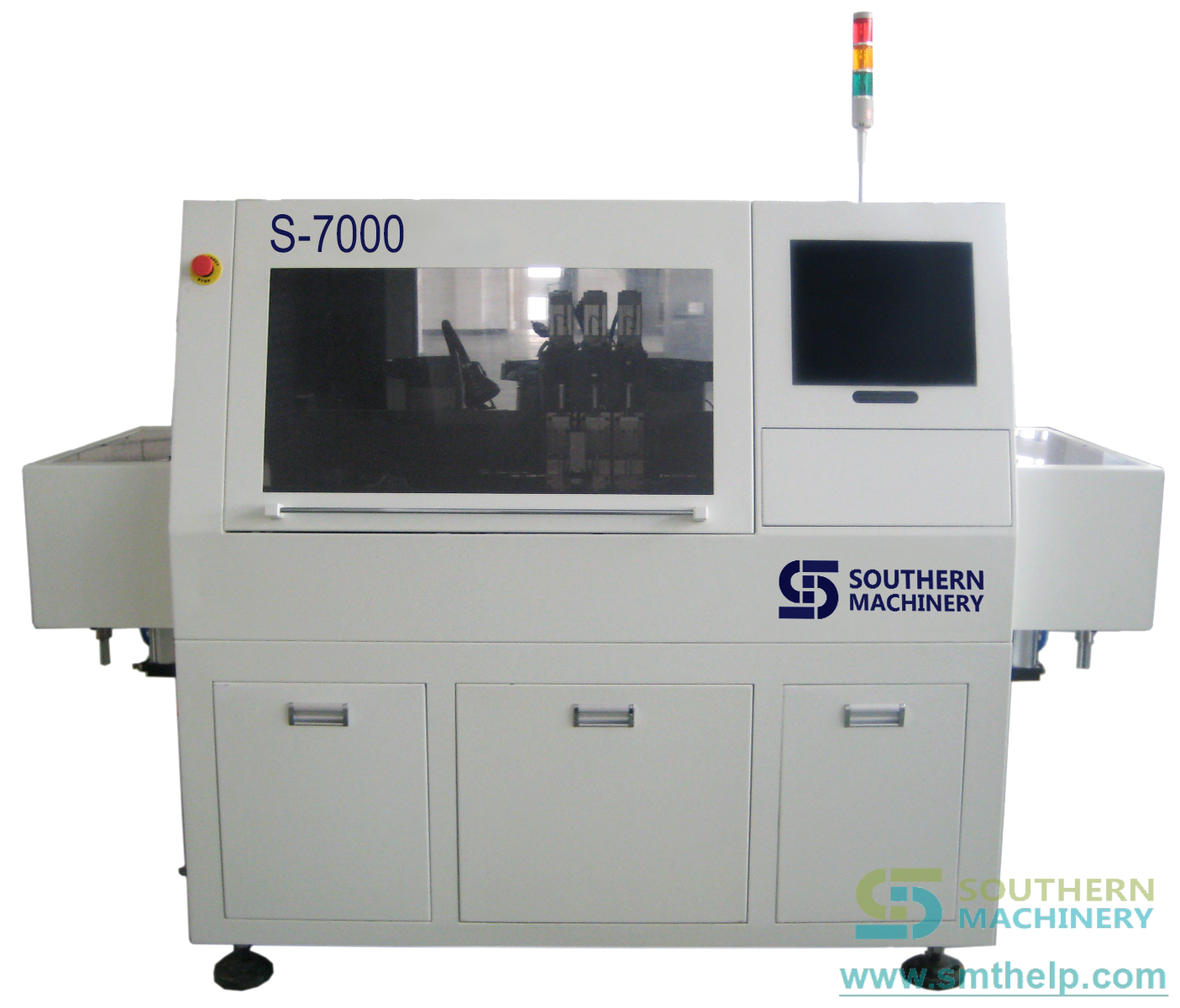
Southern Machinery's S-7000 series odd-form insertion machines automate that step. The platform feeds, forms, inserts and optionally clinches leads of 1.3–4.0 mm diameter on boards up to 480 × 390 mm, with a published throughput of up to 12,000 CPH, vision-corrected placement and 1 to 4 insertion heads.
Why manual odd-form insertion breaks quality and capacity
Hand-inserting odd-form parts fails in ways that show up after the wave, when correction is expensive:
- Bent and mis-formed leads. A 4 mm pin pushed off-axis deforms rather than seats, and the damage is often invisible from the top side.
- Missing parts and insertion height variance. Without verification, a shallow or skipped insertion reaches wave soldering unchallenged.
- Board stress. Uncontrolled insertion force stresses the laminate and the barrel — the mechanism behind cracked joints found in the field, not on the line.
- No mechanical lock before the wave. Unclinched leads let parts shift during transport and soldering, generating rework.
- Capacity tied to headcount. Output on a high-mix appliance or automotive board tracks operator proficiency, so it cannot be scheduled reliably.
The Odd-Form Readiness Audit
Four steps to establish whether your boards and parts are machine-ready — do this before requesting a quotation:
1. Classify the parts. For each odd-form component, record lead diameter (the platform covers 1.3–4.0 mm), body type — pin, round pin, switch, connector, terminal, eyelet — and packaging. Reeled terminals, tact switches and fuse holders each map to a dedicated variant.
2. Check the board design rules. Southern Machinery's published guidance: the insertion hole should be 0.5 ±0.1 mm larger than the component foot, and component bodies need at least 2 mm spacing. Board thickness must fall in 0.76–2.36 mm.
3. Decide the clinch style. Inward, outward, or none. This is a board-level decision that affects wave soldering and rework, so settle it before commissioning rather than during it.
4. Size the head count against your CPH target. The platform is offered with 1 to 4 heads; actual throughput depends on board design and component mix, so define required output first and let head count follow.
The Vehicle: how the S-7000 series works
The machine feeds an odd-form part, forms it if required, positions it with vision correction from an industrial high-definition camera, inserts it to a controlled height and optionally clinches the leads on the underside. Programming is Windows-based: Excel data can be imported over USB, and online visual programming lets an operator teach insertion points directly at the machine. The series extends into dedicated variants: the S-7000T terminal insertion machine for reeled terminals such as Zierick 1021/6021/1198/6198 and TE Connectivity TAB FASTON 6.35 mm (.250 in) or 4.75 mm (.187 in) at 5.08 mm (0.2 in) pitch, the S-7000D tact switch inserter, and the S-7000I fuse holder inserter.
Published specification for the platform:
| Parameter | Specification |
|---|---|
| Component types | 1.3–4.0 mm pin, round pin, switch, connector, terminal, eyelet |
| Throughput | up to 12,000 CPH (S-7000T: 5,000–6,000 CPH) |
| PCB size | max 480 × 390 mm (S-7000T standard 380 × 280 mm, enlargeable) |
| PCB thickness | 0.76–2.36 mm |
| Insertion heads | 1 to 4 (optional) |
| Insertion angle | 360° in 1° increments (S-7000T) |
| Clinching | inward / outward / none (optional) |
| Motion accuracy | 0.001 mm per pulse, Panasonic controller and motors (S-7000T) |
| Vision | industrial HD camera, automatic visual correction, insertion verification (S-7000T) |
| Programming | Windows software, Excel import via USB, online visual programming |
| Power | single phase 220 VAC 50/60 Hz, 1.0 kVA (S-7000T 2 kVA) |
| Air pressure | 0.4–0.6 MPa (0.55–0.6 MPa for round pins) |
| Footprint | 2140 × 1450 × 1600 mm (2-head S-7000T: 1700 × 1300 × 1600 mm) |
| Weight | approx. 1,200 kg |
| Integration | RS-232C for MES (S-7000T), loader/unloader and automatic PCB transfer options |
| Operating humidity | 30–70% |
Where it fits in a complete line
The S-7000 series is designed to sit inline between the SMT block and wave soldering. A typical flow: pick and place → reflow oven → SPI and AOI; then S-7000 odd-form insertion adds switches, connectors, terminals and eyelets once the SMT side is complete; then wave soldering → lead trimming → cleaning → final AOI. PCB transfer is automatic as an option, the machine is loader/unloader-ready for Industry 4.0, and the Windows industrial PC connects to MES over RS-232C. It also runs offline for high-mix, low-volume batches. Since Southern Machinery supplies SMT, THT, wave soldering, handling and inspection from one catalog, the SMT/THT boundary — the usual source of integration friction — is owned by one partner.
The ROI case
Model four effects against your own baseline. Capacity: the up-to-12,000-CPH platform spec replaces an operator-dependent rate; for terminal-heavy boards Southern Machinery publishes about a one-year ROI on the S-7000T. Quality: vision-corrected placement, insertion verification and insertion height control catch bent leads and missing parts before the board reaches the wave; the S-7000T meets the IPC-9704 stress standard with insertion stress held within ±400 µε — a meaningful figure for automotive and industrial boards where cracked joints become field failures. Mechanical stability: inward or outward clinch locks leads before soldering, stabilizing the board for the wave and cutting rework. Scrap: controlled forming and visual correction reduce the defect and scrap rate that manual insertion produces on delicate parts.
Treat the one-year figure as a planning benchmark, not a promised outcome. Measure your current scrap and rework on odd-form parts, project the change, commission the machine, then re-measure and feed the result back into the Odd-Form Readiness Audit. That audit-and-improvement loop tells you whether the next gain comes from an extra head, a clinch change or a board design revision.
Your next step
Send your odd-form part list, board drawings, clinch requirement and target CPH for an engineering review, and ask for a demo video of the machine running parts like yours. Southern Machinery (Shenzhen, China, since 2011, 237+ global customers) builds SMT and THT automation for EMS, ODM, appliance, power supply, automotive and LED lighting manufacturers, with installation, training and spare parts. Contact details are below.
FAQ
Which components can the S7000 insert? Pins and round pins of 1.3–4.0 mm, switches, connectors, terminals and eyelets. Dedicated variants cover reeled terminals (S-7000T, including Zierick and TE FASTON tape terminals), tact switches (S-7000D) and fuse holders (S-7000I).
What board sizes does it accept? Up to 480 × 390 mm with 0.76–2.36 mm thickness on the S7000 platform. The S-7000T standard is 380 × 280 mm, with enlarged sizes customizable.
How is it programmed? Windows-based software with Excel data import via USB, plus online visual programming using an industrial HD camera with automatic visual correction.
What throughput should I plan for? The published platform speed is up to 12,000 CPH; the S-7000T terminal machine is specified at 5,000–6,000 CPH. Final throughput depends on component mix, head count and board design.
Jason Wu
Founder & CEO, Southern Machinery (Shenzhen Southern Machinery Sales and Service Co., Ltd.)
Email: jasonwu@smthelp.com / info@smthelp.com
WhatsApp: +86 13602562576
Catalog & manuals: file.autoinsertion.com | Machine photos: ph.smthelp.com
LinkedIn: linkedin.com/in/smtsupplier | YouTube: youtube.com/c/Smthelping
Comments
Comments appear after approval.